

Scarlet Elfcup ©Mark Robinson
Fungi ID Course: Day 4
Welcome to day four
Welcome to day four of your fungi identification course. Today, you're going to learn how to identify some beautiful cup and flask shaped fungi that can be found across Dorset woodlands this autumn and winter. The name comes from the shape of the reproductive structures which resemble small cups or flasks.
Scarlet elfcup
Sarcoscypha austriaca
Statistics
When to see: January to April
Cup width: 1-5cm
How to identify
You will need to save this one for January - the scarlet elfcup is often found from late winter to early spring on fallen twigs and branches, buried within moss.
The scarlet elfcup has rounded, regular-shaped fruiting bodies that look like cups; they have a bright scarlet and smooth inner surface. The outer surface is pale pink and covered in tiny hairs. The cup has a very short stem.
Did you know?
The ruby elfcup is very similar in appearance to the scarlet elfcup (Sarcoscypha austriaca). There's no physical difference. You can only tell them apart by microscopy (tiny fine hairs are the difference).
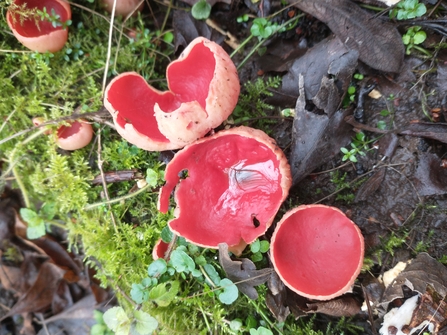
Mariko Whyte / Scarlet elfcups
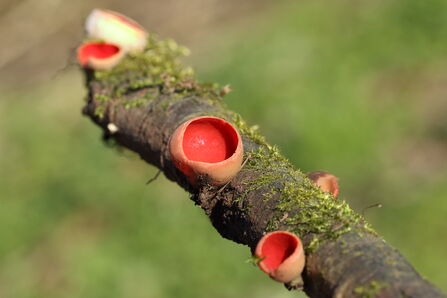
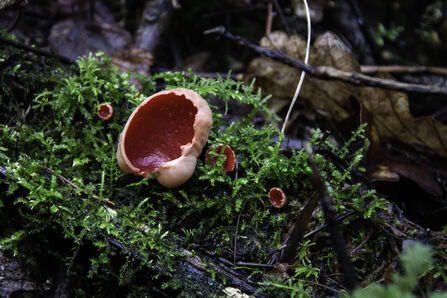
Scarlet Elfcup ©Mark Robinson
Green elf cup
Chlorociboria aeruginascens
Statistics
When to see: September to February
Cup width: 1-5mm
How to identify
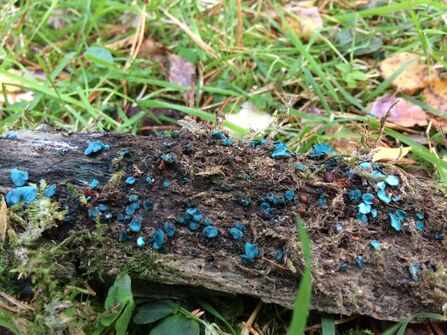
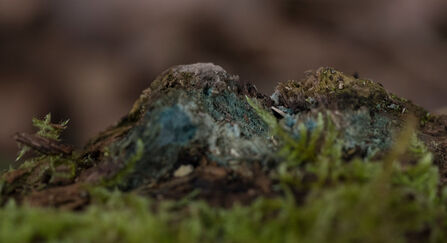
These tiny fungi inhabit dead branches on the woodland floor - turning them a beautiful turquoise green colour.
The green elf cup is a very distinctive colour and size, which makes it easier to identify. If you look closely you should be able to spot a short stem underneath the cups. Over time the cups flatten out to resemble a disc shape as in the photo above.
Did you know?
The wood that this fungus infects, known as 'green oak' was highly prized by fine woodworkers in the 18th and 19th centuries, who used this to great effect in their intricate inlays for decorative wooden boxes. Crafting mosaic patterns from different pieces of stained wood like this was the signature craft of woodworkers who made 'Tonbridge Ware' of Kent.
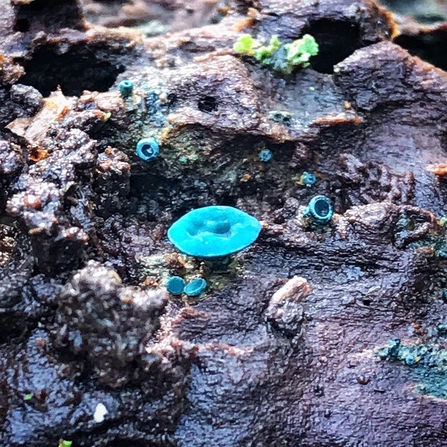
Ali Mckernan
Ali Mckernan
Chris Lawrence
Cedar cup
Geopora sumneriana
Statistics
When to see: December to May
Cup width: 4-7cm
How to identify
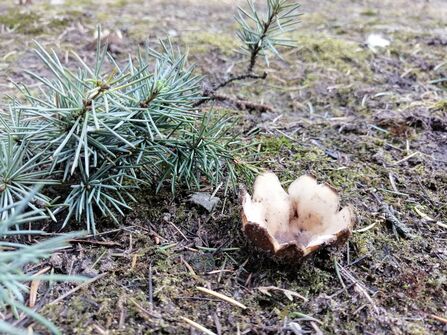
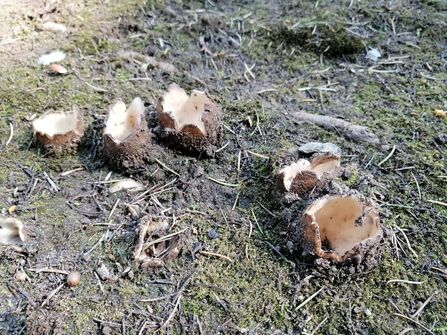
The cedar cup forms initially underground for most of its time, as a sphere. It then bursts through the soil, revealing it’s pointed rays and cupped shape.
This is the largest of similar cup-like fungi. It has a dark brown outer surface which is covered in very fine hairs, with a pale cream inside. As it matures, it splits into between 5-8 rays creating the crown-like shape seen in the image above. As the name suggests, this fungus grows almost exclusively at the base of cedar trees.
Did you know?
This particular fungus is an 'Ascomycete', meaning it shoots its spores out from the inside surface. You can sometimes visibly see this if you blow onto on a sheltered fruitbody. It will look as though the cup is smoking!
Ali Mckernan
Ali Mckernan