Day 2: Meadow Wildflowers
Welcome to day 2
Today, we're turning our attention to some of Dorset's wildflower meadows. Usually blooming from April to August, wildflower meadows burst into life with a variety of bright florals buzzing with busy insect life. Dorset Wildlife Trust manages several wildflower meadows which are free to visit, including Kingcombe Meadows and Corfe Mullen Meadows.
Common knapweed
Centaurea nigra
Statistics
When to see: June to September
Height: Up to 1m
How to identify
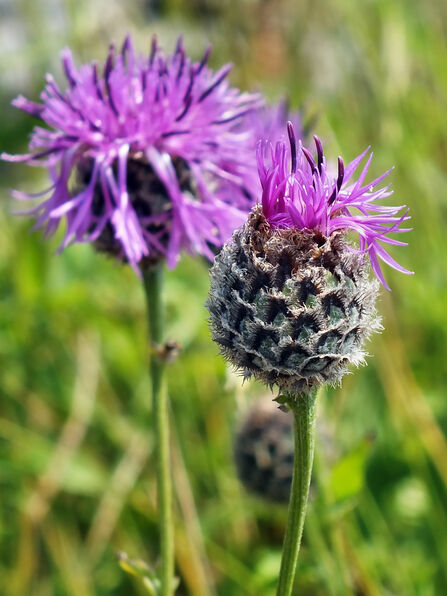
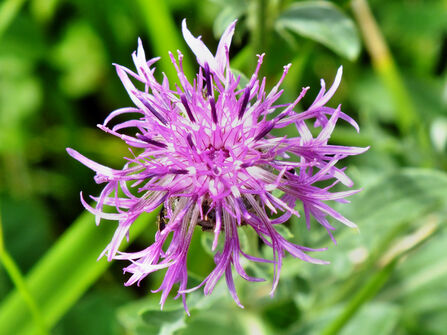
Common knapweed is often found on a wide range of grassland and is a favourite of all kinds of butterflies, including common blues, marbled whites and meadow browns. It has bright pink-purple 'flowers', which are composite flower heads made up of many small 'florets' (tiny flowers), surrounded by a crown of long, ragged, pink bracts (leaf-like structures). It has deeply divided, oblong leaves.
Did you know?
Due to its hardy and fast-spreading nature, common knapweed is considered an invasive plant in North America.
Devil’s-bit scabious
Succisa pratensis
Statistics
When to see: July to October
Height: Up to 75cm
How to identify
Devil's-bit scabious can be found in damp meadows and marshes, alongside woodlands and some riverbanks. This wildflower has flattened, rounded flower heads that range in colour from blue to pinky-purple. Its leaves are long and oval, and differ from those of field scabious, which are dark green, hairy and deeply lobed.
Did you know?
Devil's-bit scabious gets its Latin name - 'Scabere', meaning to scratch - from its traditional use as a treatment for skin conditions, such as scabies and the sores of bubonic plague. Its common name arises from the fact that its roots look truncated, as if bitten off - legend has it, by the Devil.
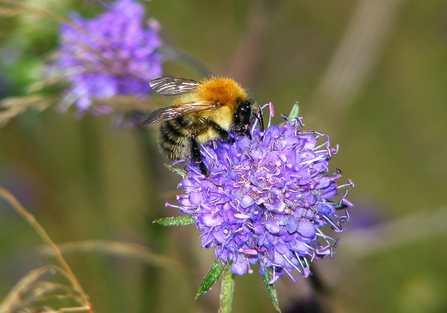
Common carder bee on Devil's-bit scabious © Jane Adams
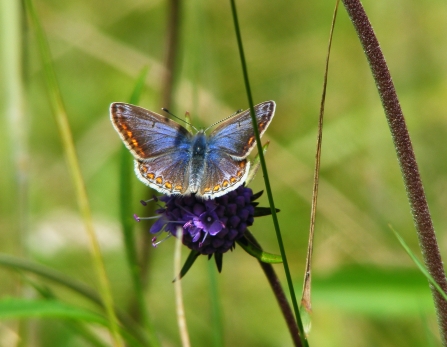
Common blue butterfly on Devil's-bit scabious © Jane Adams
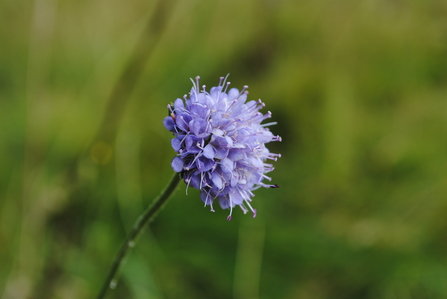
Amy Lewis / Devil's-bit scabious
Ragged-robin
Lychnis flos-cuculi
Statistics
When to see: May to August
Height: Up to 75cm
How to identify
The pink, frayed flowers of ragged-robin are an increasingly rare sight and are found in wildflower meadows, damp pasture or woodland rides. This wildflower can be identified by its much-divided, pink flowers (hence the name 'ragged') and narrow, grass-like leaves
Did you know?
Perhaps you don't know what to do with a waterlogged area of your garden, or you fancy extending the borders of your pond to make it more wildlife-friendly? If this is the case, a bog garden could be the ideal answer. Moisture-loving plants, such as ragged-robin, will thrive here, attracting dragonflies, bees and butterflies, which, in turn, bring frogs, toads and other animals.
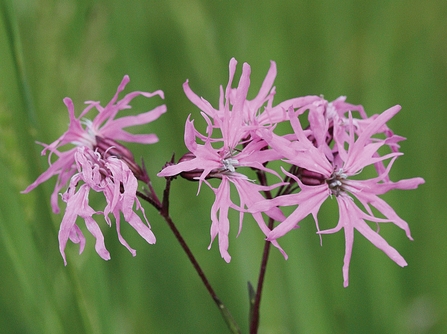
Dorset Wildlife Trust
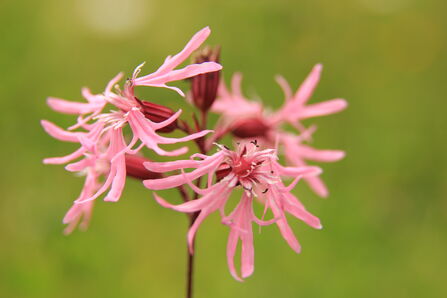
Cowslip
Primula veris
Statistics
When to see: April to May
Height: Up to 25cm
How to identify
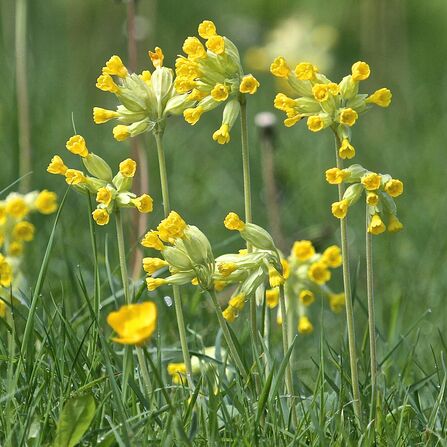
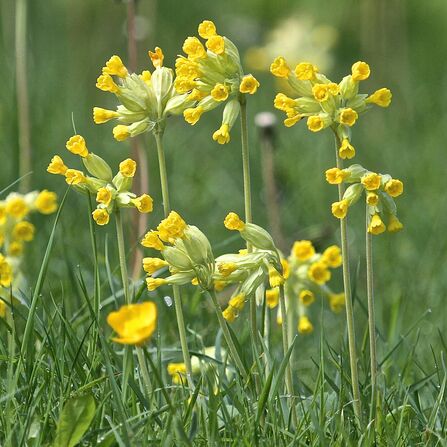
The cowslip is a cousin of the primrose and is also an early spring flower. Formerly a common plant of traditional hay meadows, ancient woodlands and hedgerows, the loss of these habitats has caused a serious decline in its populations. Now fields coloured bright yellow with its nodding heads are a rare sight. This flower displays a rosette of green, crinkly, tongue-like leaves, low to the ground. Its tube-like, egg-yolk-yellow flowers are clustered together at the ends of its upright, green stems.
Did you know?
The cowslip has many folk names due to its historical importance and fame, including 'key of heaven', 'paigles', 'bunch of keys' and 'herb Peter'. The name cowslip actually means 'cow-slop' (i.e. cowpat), in reference to its choice of meadow habitat. The cowslip is the county flower for Essex, Northamptonshire, Surrey and Worcestershire.
The Wildlife Trusts manage many grassland and woodland habitats sympathetically for the benefit of all kinds of wildlife. Careful grazing with traditional breeds, hay-cutting at the right time, scrub clearance and coppicing are just some of the ways grasslands and woodlands are kept in good condition.
Hamish Murray