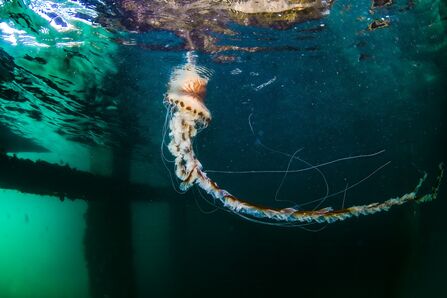
Day Five: Jellyfish
Welcome to day five
On day five of the course, we're looking at three jellyfish that are commonly found around the UK coast. They are ancient marine invertebrates, made up of around 95% water. It’s best to be careful around this group of species - they can sting!
Moon jellyfish
Aurelia aurita
Statistics
When to see: All year round
Size: Diameter can vary from 5-40cm
How to identify
Moon jellies are common in UK seas and you will often find them washed up on shore.
Around the size of a plate, it is recognisable by the four circles visible through the translucent white bell. These four circles are gonads, the reproductive organs located at the bottom of the stomach, and they are normally purple in colour. You can usually see these jellyfish floating just below the surface of the water - they can give a mild sting.
Did you know?
Moon jellyfish have two main stages to their lifecycle: polyp and medusa. The latter is the adult, bell-shaped, floating jellyfish we are familiar with. The former is a small stalk that attaches to a rock and divides into buds that break free to become adults.
Blue jellyfish
Cyanea lamarckii
Statistics
When to see: May to October
Size: The bell is up to 30cm in diameter
How to identify
Blue jellyfish are attracted inshore by blooms of plankton that provide a plentiful supply of food. The blue jellyfish can drift along, easily capturing prey with its dense array of stinging tentacles.
To identify, look for a dome-shaped bell and stinging tentacles trailing underneath. The bell colour depends on maturity and can vary from pale yellow to purple. Paler (younger) individuals are easily confused with the larger lion's mane jellyfish. Be careful - as this jellyfish can sting.
Did you know?
A group of jellyfish is known as a “smack”, but is more commonly referred to as a “bloom”.
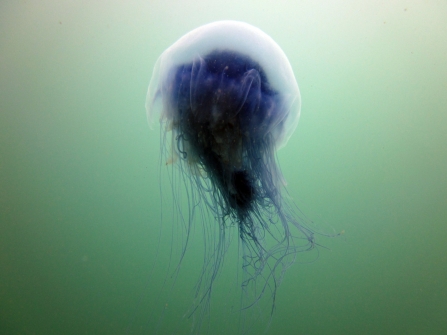
Blue Jellyfish © Andy Marsh
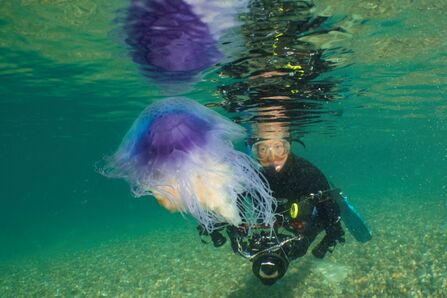
Compass jellyfish
Chrysaora hysoscella
Statistics
When to see: May to October
Size: The bell is up to 30cm in diameter
How to identify
This jellyfish is a summer visitor to our shores and feeds on small fish, crabs and even other jellyfish. To identify - look out for a jellyfish with a translucent yellow-white colour and brown marking on the top and fringe. The markings atop the bell resemble a compass, with V-shapes radiating out from a central point. They have a bunch of frilled oral arms below the bell and long thin marginal tentacles around the fringe of the bell.
This is a jellyfish to be careful of, as they give a nasty sting!
Did you know?
Once they have stung something, jellyfish often leave the tentacle behind and can continue to sting using it even when not connected to their body.
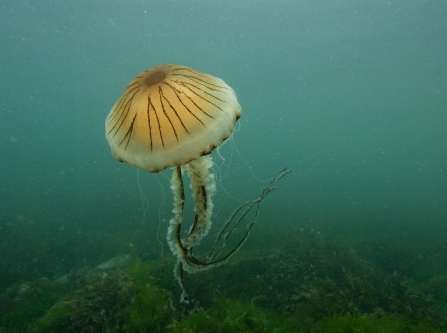
Compass jellyfish © Paul Naylor