

Sarah Hodgson/Jess Kenneally
Day Six: Sea Snails
Welcome to day six
Today we are looking closer to shore as we explore the interesting world of sea snails!
While they may be a common sight across rocks and rockpools at the coast, how much do you actually know about this diverse set of creatures?
Sea snails are a type of gastropod - which derives from an ancient greek term meaning ‘stomach foot’. This refers to the singular muscular foot at the base of these molluscs which allows them to move - the same as your garden slugs and snails. Read on to find out how to identify the types when you are next at the seaside!
Common limpet
Patella vulgata
Statistics
When to see: All year round
Size: Up to 4cm in diameter
How to identify
Limpets are a common seashore sight, often attached to the side of rocks and rockpools, waiting for the tide to come in before they can move and feed. They eat algae, using their tongue to scrape it off the rocks.
There are three very similar species of limpet found on UK shores. The common limpet has a greyish, conical shell and is slightly larger than the other two - most differences are found on the underside of the shell. You must however never remove them from the rock to identify, but taking a photo can be a good way to study or ask advice on which type of limpet you’ve found.
Did you know?
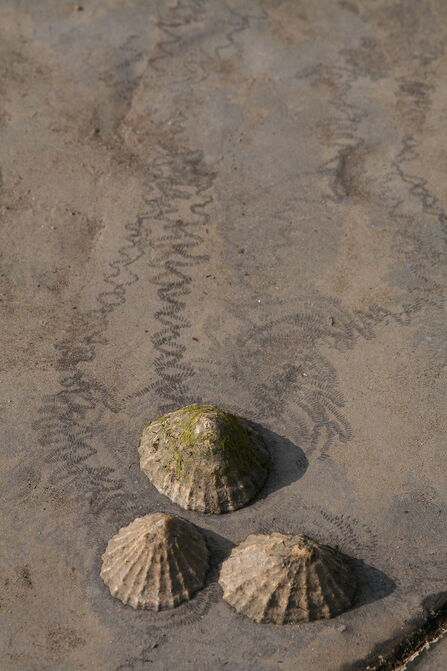
Limpets move around over the rocks when the tide is in, but always return to their own favourite spot when the tide goes out, following the mucus trail that they have deposited. This spot becomes worn by the edges of the shell, and eventually an obvious 'scar' in the rock is created. This 'home scar' helps the limpet to better attach to the rock, stopping it drying out until the next tide comes in.
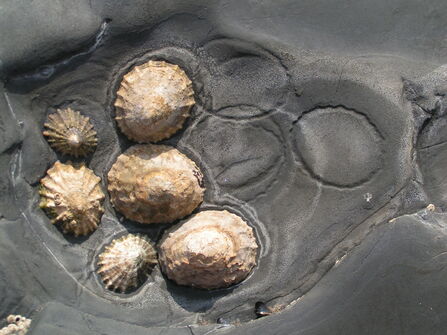
Limpets ©Richard Burkmar

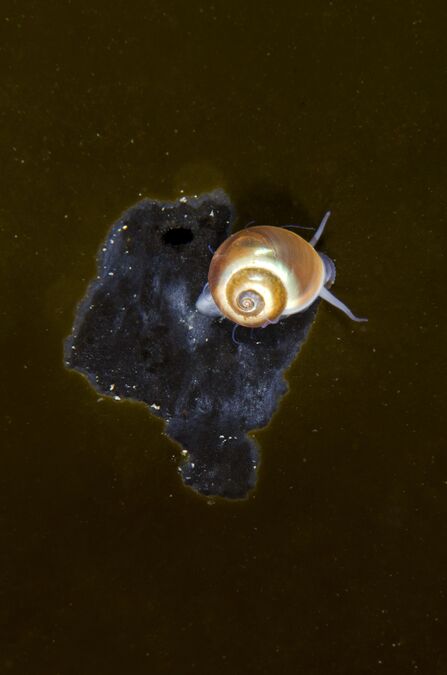
Flat periwinkle
Littorina obtusata/fabalis
Statistics
When to see: All year round
Size: Up to 1.5cm in diameter
How to identify
This snail is often found on the lower parts of the shore, amongst seaweed, which is its source of food. It is most commonly associated with bladder wrack seaweed and can be mistaken for the air bladders that make the seaweed float.
Flat periwinkles come in many different colours including orange, bright yellow, banded brown and olive green. There are also two species of flat periwinkle but they can’t be identified externally, hence the obtusata/fabalis in their latin name. If recording this species it’s important to use both names.
Did you know?
Periwinkles are able seal themselves into their shell by closing the 'door' - a round operculum. Flat periwinkles can breed throughout the year and have both male and female forms. Eggs are internally fertilised and laid on seaweed in masses of up to 280 eggs.
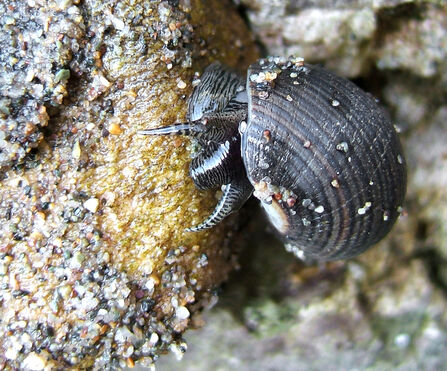
Dog whelk
Nucella lapillus
Statistics
When to see: All year round
Size: 3-6cm in length
How to identify
Dog whelks are usually found on the lower shore wherever there are barnacles or mussels - their favourite food, and once they have fed they will find a crevice in which to rest for a few days before feeding again.
To identify, look for a conical shell with a pointed spire - predominately these are white but can also be brown or yellow. It is smaller than the common whelk, smoother than the netted whelk and more rounded than the oyster drill.
Did you know?
The dog whelk feeds on mussels and barnacles by boring through their shells. It then injects enzymes to digest the prey within its shell, sucking the resulting 'liquid soup' out through its proboscis. It can take days to eat its prey this way.
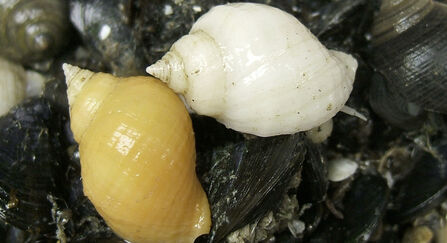
Dog whelk by Alan Price
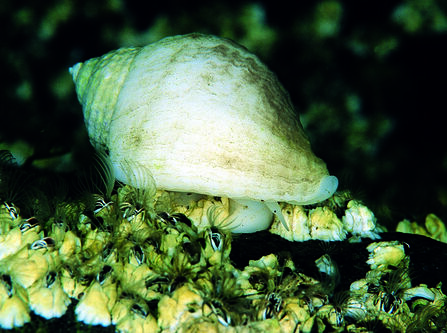
Dog Whelk ©Paul Naylor