
Louis Pulford, 2024 photography competition / Fly agaric
Day three: Toadstools and Mushrooms
Welcome to day three
Today, we are heading into the woodland as we look for some of the most iconic mushrooms, straight from the pages of a fairytale.
The term ‘toadstool’ conjures up images of a red-capped fungus with white spots - the name is thought to come from old mythology where these species were thought to look like a stool where a toad could sit and catch flies.
The category of ‘mushrooms’, tends to be another term for a mixture of fungi with distinctive stems and large caps, and edible variants such as you buy at the supermarket.
Remember - you should never attempt to forage or eat any of these wild fungi.
Fly agaric
Amanita muscaria
Statistics
When to see: August to November
Cap width: 8-20cm
How to identify
Fly agaric is found in woodlands, parks and heaths with scattered trees, typically growing beneath birch trees or pines and spruces. The colourful fruiting bodies can usually be seen between late summer and early winter.
These distinctive mushrooms have a red cap, either flat or rounded, often with a scattering of white spots or warts, and a white stem. Beneath the cap, they have gills which are free of the stem.
Did you know?
Despite it being toxic to us, there are some animals that do eat fly agaric. These include red squirrels and slugs, as well as specialists such as fungus gnats - these flies lay eggs on the fungus, and when they hatch the larvae feed on the fruiting body.
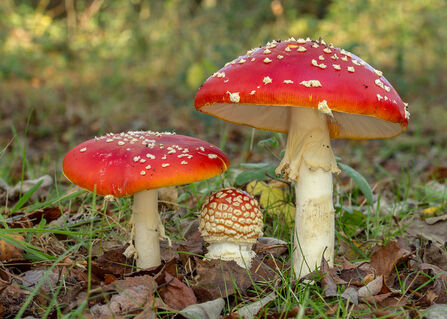
Chris Rowland / Fly agaric

Fly agaric in woodland setting © Ben Hall/2020VISION
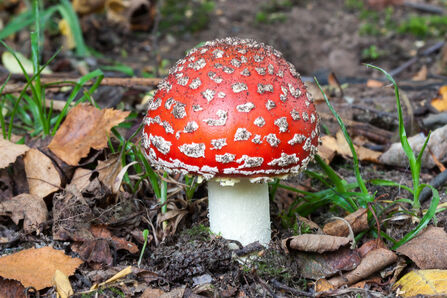
Fly agaric ©Mike Snelle
Shaggy inkcap
Coprinus comatus
Statistics
When to see: May to November
Cap width: 5-15cm
How to identify
Shaggy inkcaps are widespread and common on roadside verges, parkland, grassland and gardens, growing in small groups.
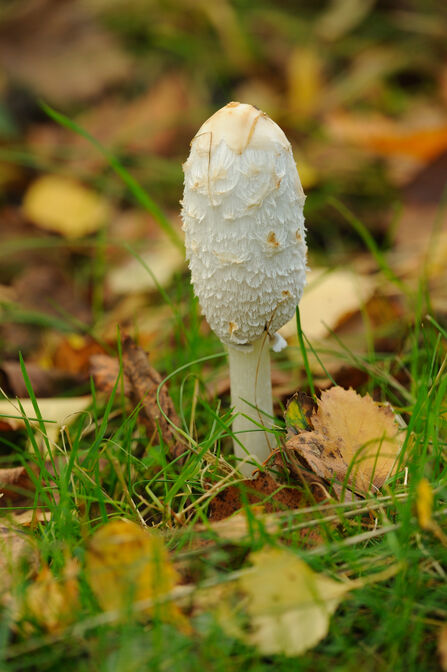
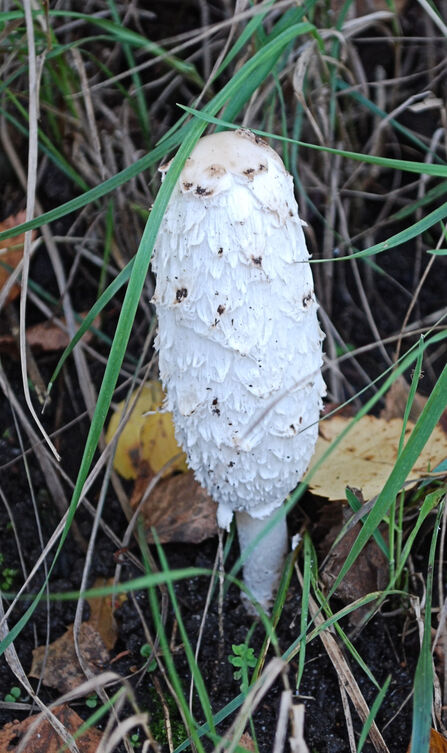
This fungus has a tall, narrow, cylindrical cap in a bell shape which is white and ‘shaggy’ with scales running over the surface. It has crowded gills which turn from white to black over time before dissolving completely. It has a tall and smooth stem and the cap starts out closed before opening up into the bell shape.
Did you know?
The name 'inkcap' refers to the process this fungus goes through to reproduce - it's cap and gills naturally dissolve into a black spore-rich liquid.
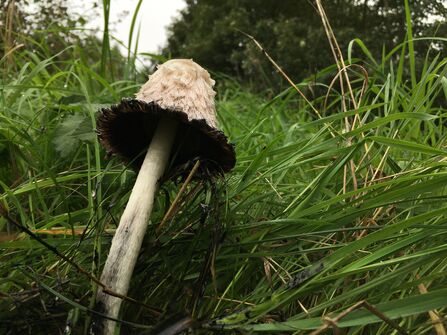
Shaggy Inkcap ©Tom Hibbert
Shaggy Inkcap ©Amy Lewis
Amethyst deceiver
Laccaria amethystina
Statistics
When to see: August to November
Cap width: 1-6cm
How to identify
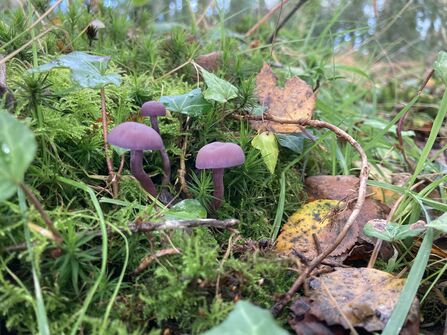
The amethyst deceiver can be seen growing in broadleaved and coniferous woodlands among the leaf litter.
It is widespread and an unusual colour - bright purple. It has lilac flesh and the gills are attached to the stem - these are widely spaced and dark purple. The stem is covered in small white hairs.
Did you know?
During dry spells, and as the amethyst deceiver gets older, its cap and stem become much paler in colour and can even turn white.
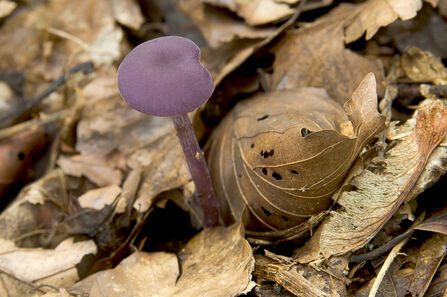
Amethyst Deceiver ©northeastwildlife.co.uk