

© Sarah Hodgson
Day One: Crustaceans
Welcome to day one
Welcome to the first day of your seashore identification course. Today, you're going to learn how to identify three crab species you might spot on Dorset’s coastline.
Crabs are crustaceans, which is the term used for a set of mostly aquatic invertebrate species, defined by their hard outer exoskeleton, jointed legs and antennae. An exciting rockpool find, the UK has a number of native crustaceans which thrive on the shores of Dorset. We hope you’ll enjoy identifying these species, but it’s important to remember to abide by the seashore code!
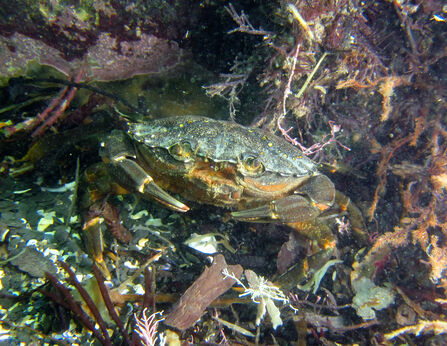
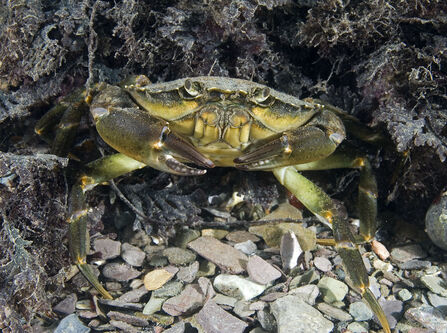
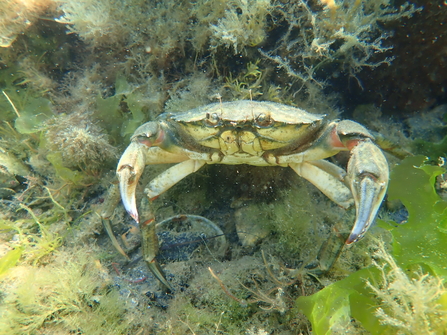
Shore Crab
Carcinus maenas
Statistics
When to see: All year round
Size: Shell width is up to 9cm
How to identify
The shore crab is normally green-ish in colour but it can be orange or even red. It is medium sized and can be identified by the pattern of spikes on its shell (carapace).
You can also look out for whether it has five upturned spikes on each side of the carapace and three rounded lobes between the eyes (a pattern of five, three, five). The different colourations are related to the crab's age and whether it is breeding season.
Did you know?
The shore crab can suffer from an unusual parasite - the crab hacker barnacle. This barnacle castrates the crab before using it as a host for it's own eggs - you can see when this has occurred as they will be carrying a pale mass on their underside (whereas a female would usually have a mass of orange eggs).
Velvet swimming crab
Necora puber
Statistics
When to see: All year round
Size: Shell width is up to 10cm
How to identify
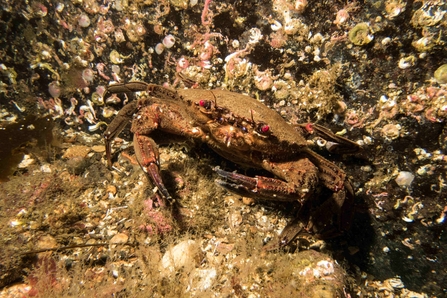
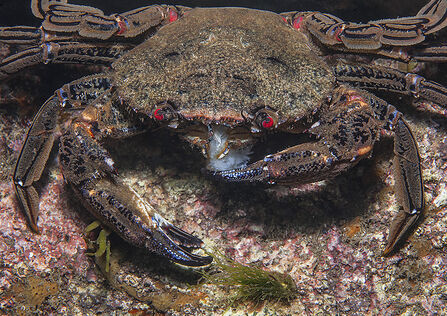
The velvet swimming crab is a medium sized crab with distinctive bright-red eyes. Their bodies are covered in short hairs, giving them a velvet appearance. You can look out for blue lines on their legs and blueish tips to their strong claws.
Did you know?
It is also known as a 'Devil crab' - either thought to come from their bright red eyes or their feisty nature as they are known to give you a painful nip!
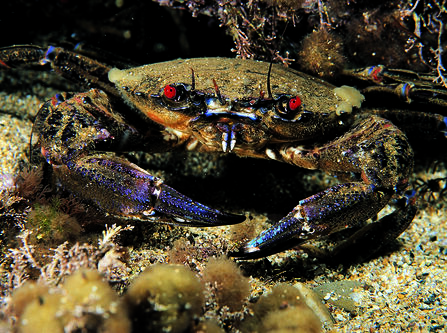
Velvet swimming crab ©Paul Naylor
Julie Hatcher / Velvet swimming crab
Edible crab
Cancer pagurus
Statistics
When to see: All year round
Size: Shell width is 10-20cm
How to identify
The edible crab is a large crab, brown in colour apart from black tips on the end of its claws. Their thick, oval shaped shell is unique - with a distinctive pie-crust edge.
Did you know?
The edible crab is the most commercially important species of crab in Europe - 10,000 tonnes of edible crab are harvested from the English Channel every year.
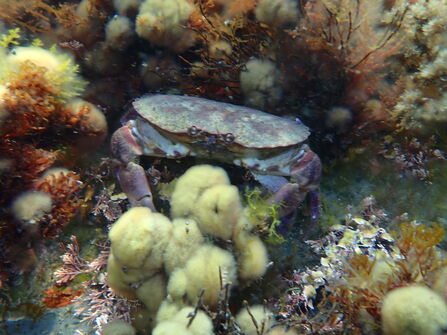
Lily Burnet / Edible crab in Kimmeridge Bay
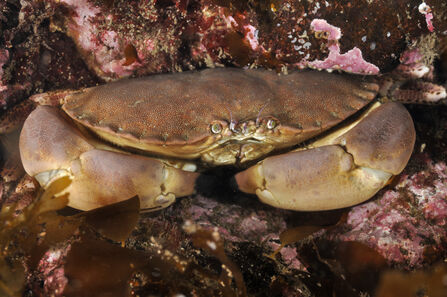
Edible Crab ©Linda Pitkin/2020VISION
