

Emma Bradshaw
Day 6: Chalk Grassland Wildflowers
Welcome to day 6
On day 6 of the course, we're looking at three flowers that are commonly found on chalk grassland. Chalk grassland is an ancient and rare habitat, teeming with wildlife. In the last 70 years, an estimated 80% of Britain’s chalk grassland has been lost, but in Dorset you can still visit this unique habitat, at reserves such as Fontmell Down.
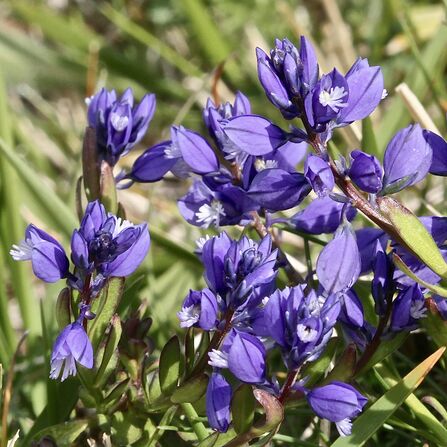
Chalk milkwort
Polygala calcarea
Statistics
When to see: May to July
Height: Up to 5cm
How to identify
The chalk milkwort is a rare wildflower, usually found on grazed chalk and limestone grassland in the UK. It can be identified by its small purple flowers with a frilly lobed white lower petal. The small oval leaves are at the base of the plant in a circular arrangement.
Did you know?
The chalk milkwort remains fairly common within its core areas (one of which is Dorset) but it has been lost from many sites since the 1960s largely due to the increase in grazing and consequent growth of coarse grass and scrub.
Corky-fruited water dropwort
Oenanthe pimpinelloides
Statistics
When to see: June to August
Height: Up to 1m
How to identify
This flower is mostly found within the counties of Dorset, Somerset and Hampshire on chalk grassland with low acidity soil. To identify, look out for the divided, fern-like leaves with a large amount of small white flowers in umbels (a set of short flower stalks that spread from one point, resembling an umbrella).
Did you know?
Its national distribution is centred on Dorset, Hampshire and Somerset, becoming very rare away from the south of England. Unlike other water-dropworts, it can be found on fairly dry soils. It is considered to be potentially poisonous to humans and animals if ingested.


Early spider orchid
Ophrys sphegodes
Statistics
When to see: April to May
Height: Up to 20cm
How to identify
This rare orchid is most likely to be seen in Dorset in the Purbeck area, such as at Townsend Nature Reserve in Swanage. Each specimen can have from two to 18 flowers, and they are identified by the deceptive appearance of the petals which resemble a spider. The lip is a velvety dark reddish-brown with distinctive shiny H-shape marking (known as a mirror) on top.
Did you know?
They have an unusual method of pollination. Closely related to the bee orchid, this flower mimics the appearance of a female solitary bee (despite its arachnid name), tricking males into attempting to mate, thus allowing them to pick up and spread their pollen!
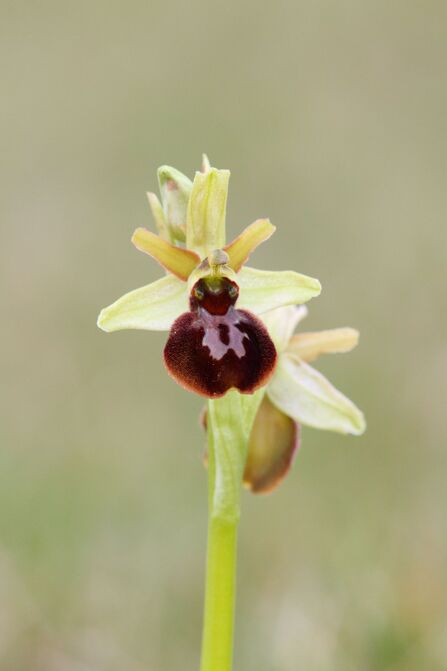
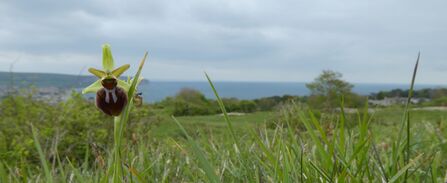
Early spider orchid © James Hitchen
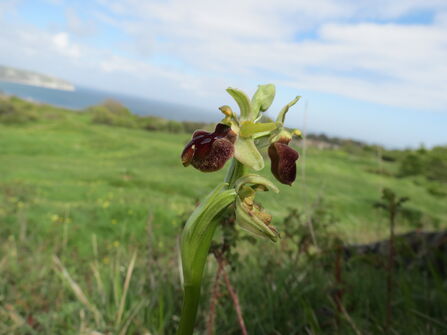
Early spider orchid © Neil Gibson