

© Sarah Hodgson
Day Four: Rockpool Stars
Welcome to day four
Welcome to day four of your seashore identification course. Today, you're going to learn how to identify some exciting star-shaped creatures which you might find in rockpools across Dorset. Why not visit Kimmeridge Bay and see if you can find them? Remember to always follow the seashore code when rockpooling.
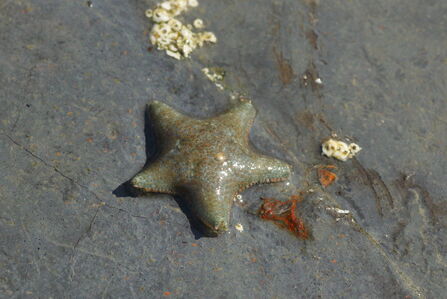
Cushion star
Asterina gibbosa
Statistics
When to see: All year round
Size: Up to 5cm in diameter
How to identify
It’s a small starfish with five (occasionally four or six) very short, broad arms. It has a puffy appearance, like a cushion and the dorsal surface (top side) is rough with projecting spines. The ventral surface (underside) is flat, with the mouth at the centre. Each of the mouth's plates bear two spines and it’s most commonly pale orange, brown, green or cream.
Did you know?
All cushion stars are born male! It is a "protandrous hermaphrodite", meaning that small or young individuals are males but when individuals increase beyond a certain size, they develop into females.
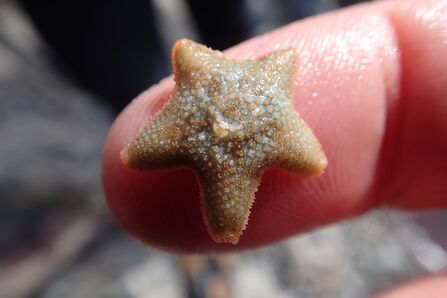
Cushion star ©Matt Slater
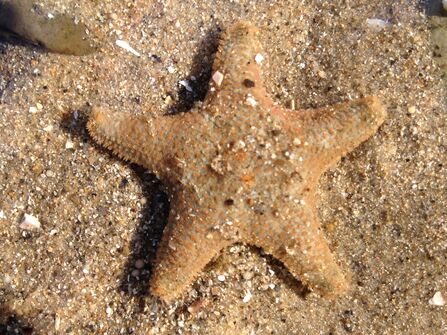
© Sarah Hodgson
Common brittlestar
Ophiothrix fragilis
Statistics
When to see: All year round
Size: Up to 2cm in diameter
How to identify
Brittlestars are related to starfish and live up to their name - they will shed parts of their arms if they are disturbed or feel threatened. So, look but don't touch!
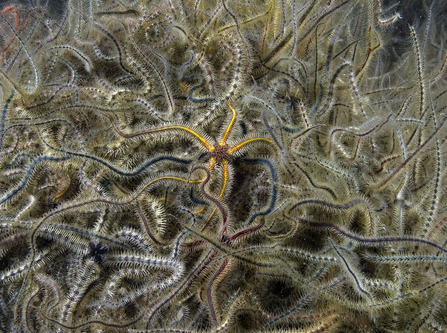
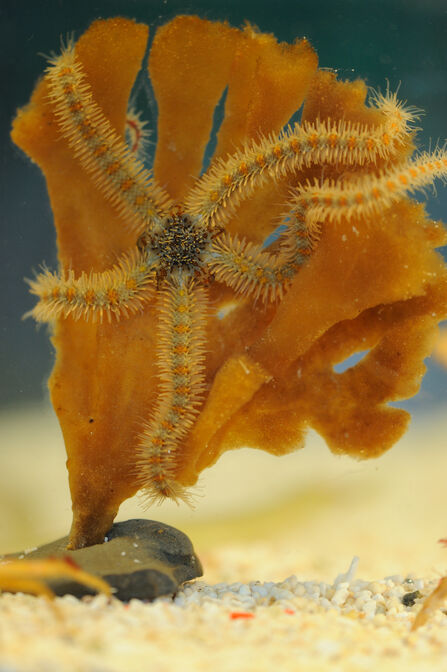
There are several species of brittlestar found in British seas, which can be difficult to tell apart. Common brittlestars vary in colour, from dull brown to purple, red, orange and yellow. They have a rounded disc-like body with five long, thin flexible arms, which are patterned with coloured bands.
Did you know?
Brittlestars are often eaten by their larger relatives, the common starfish and the spiny starfish. They hide in cracks and crevices to avoid being eaten, but can also detect a type of chemical produced by their starfish predators and so will move away!
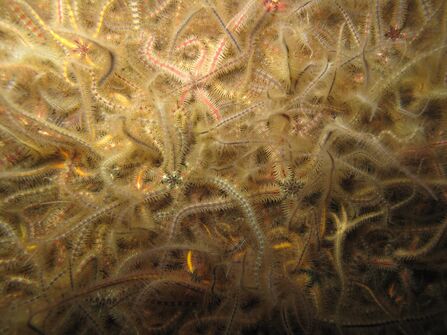
Common Brittlestars ©Polly White/Earth in Focus
Common Brittlestars © Paul Naylor
Star ascidian
Botryllus schloserri
Statistics
When to see: April to October
Size: Colonies can be from 10-20cm in diameter
How to identify
This is a colony of sea squirts that look like a bunch of beautiful flower petals stuck next to each other to form a mosaic of stars. It takes three to twelve individuals to produce one of the star-shaped patterns.
Star ascidian have a dark, flat, gelatinous structure (tunic) with petal/star patterning covering the tunic. They often vary in colour from clear to yellow to light brown stars.
Did you know?
Individual star ascidians have their own intake siphon to allow nutrients and oxygen to flow into their cells, but they share an outflow opening in the centre of the star!
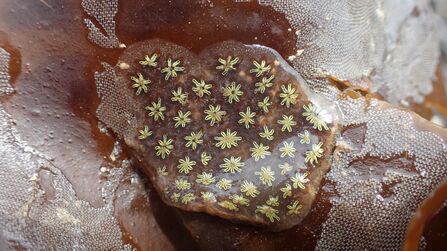
Star ascidian by Wembury Marine Centre
