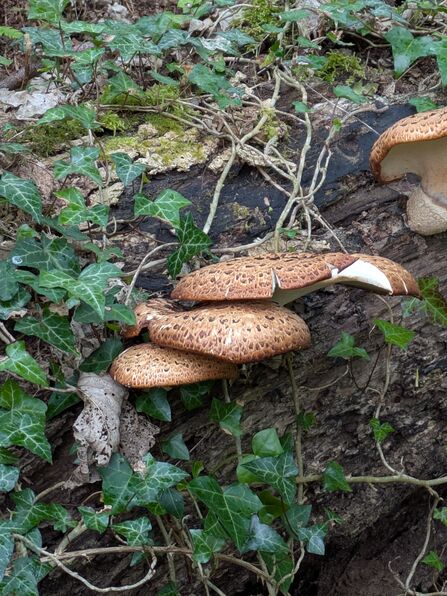

© Ben Porter
Day One: Bracket Fungi
Welcome to day one
Welcome to the first day of your fungi identification course and thank you for being a fungi fan! Today you will learn about three species classified within the group of bracket fungi. It is very important that you do not use any of our ID guide for foraging or consuming wild fungi - as many are very poisonous.
Bracket fungi, also known as shelf fungi, grow on the trunks and branches of trees (both dead and alive). They can be are either parasitic or saprotrophic, feeding on either the heartwood of live trees or decaying deadwood, making them very adaptable. Saprotrophic fungi are efficient decomposers and break hardwood down into usable nutrients for other organisms.
Turkeytail fungi
Trametes versicolor
Statistics
When to see: All year round
Cap width: 4-10cm
How to identify
The turkeytail is a common, small, tough, bracket fungus that grows in tiered layers on deadwood - mainly hardwood, such as beech or oak.
Turkeytail forms semi-circular caps around tree trunks. The caps are thin and tough, with very clear, velvety, concentric rings of colour. Colours are variable mixes of brown, yellow, grey, purple, green and black, but the outer margin is always pale - either cream or white. The caps are often layered together, forming tiers.
Did you know?
The turkeytail is a very colourful fungus and was once popular as a table decoration; at one time, it was even used to decorate hats!
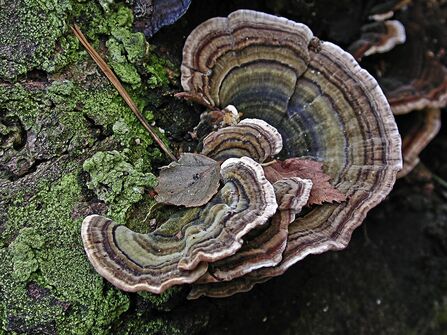
Turkeytail ©Les Binns
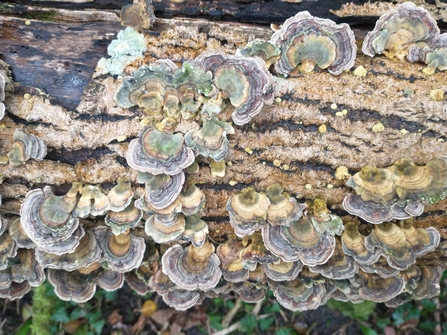
Mariko Whyte / Turkeytail

Turkeytail © Vaughn Matthews
Chicken of the woods
Laetiporus sulphureus
Statistics
When to see: June to November
Cap width: 10-40cm
How to identify
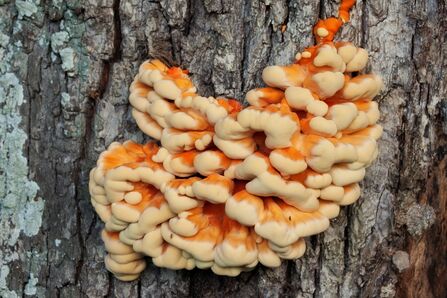
The chicken of the woods is an easy-to-spot bracket fungus due to its distinctive colour and it grows high up on the trunks of standing deciduous trees, such as oak.
The chicken of the woods is a bright sulphur-yellow fungus comprising several thick, overlapping brackets. The individual brackets are soft and spongy when young and exude a yellow liquid if squeezed. They are fan-shaped with an undulating margin. The upper surface is velvety and yellow-orange, while the underside is yellow and covered with pores.
Did you know?
The chicken of the woods gets its name from the texture of its flesh, which is said to resemble cooked chicken.

Chicken of the woods © Vaughn Matthews

Dryad's saddle
Cerioporus Squamosus
Statistics
When to see: May to September
Cap width: 5-60cm
How to identify
Starting out as stout little ‘ears’, this fungus grows rapidly into beautiful saucers, often in tiers all down the side of the tree upon which it lives. The cap surface is pale cream/golden and has a pattern of brown scales on top, which also gives it its other nickname, 'pheasants back', as it resembles the feather pattern of a pheasant.
Did you know?
Some fungi have the most unusual smells, and this fungus is no exception. It smells of watermelon! It is parasitic on deciduous trees and can become saprotrphic (recycling the dead wood).
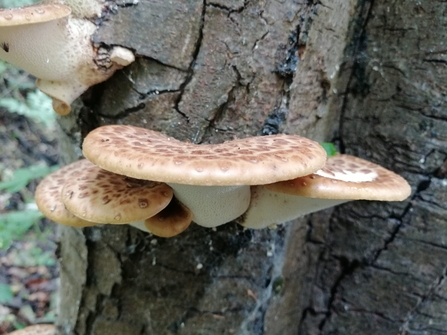
Ali McKernan
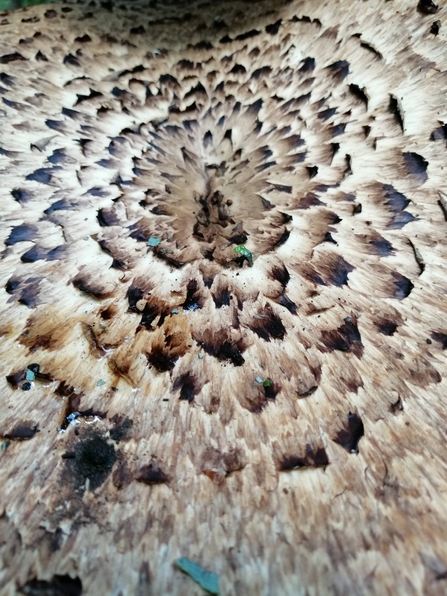
Ali Mckernan