

Day Two: Puffballs and Earthstars
Welcome to day two
Today, we're turning our attention to the fascinating and strange world of puffballs and earthstars.
Puffballs (not to be confused with the similar looking poisonous earthballs) are a type of fungus with a ball shaped fruiting structure. When mature, the body bursts releasing a cloud of dust-like spores into the air.
Earthstars are often found in woodlands, and have a distinctive star-like shape - a spore sac in the middle and ‘rays’ (imagine petal-shaped sections) around the edge which in some species can close up to protect the spore sac.
Giant puffball
Calvatia gigantea
Statistics
When to see: July to November
Width: 10-80cm
How to identify
The giant puffball is a large fungus, often around the size of a football. It grows on grass verges, field and woodland edges, and amongst rank vegetation. They are saprotrophic, which means they feed on dead organic matter.
A very large, often roughly spherical white fungus, with thick leathery skin. The skin becomes browner as it ages.
Did you know?
There's a report from 1877 of a giant puffball that measured 1.63m long, 1.37m wide and 0.24m tall!

Giant puffball © Dr Malcolm Storey
Common puffball
Lycoperdon perlatum
Statistics
When to see: July to November
Width: 2-6cm
How to identify
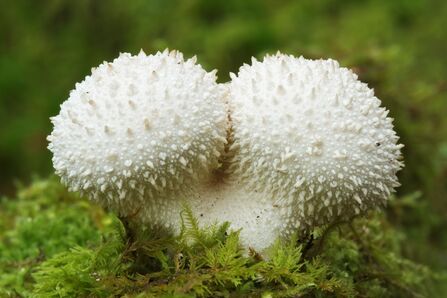
The common puffball grows on the ground in woodlands and grasslands, often occurring in small clusters. When a fruiting body is mature, a hole opens at the top, which releases spores when touched.
The common puffball is pear or club shaped, and you can see the stem. They start out white before becoming browner with age, with small scars on the surface (left by small warts which break off over time).
Did you know?
The fruiting bodies of the common puffball are pear or club-shaped, with an obvious stem. They're whitish at first, becoming browner with age. The surface is covered with short, bobbly warts. These break off as the puffball ages, leaving little scars on the surface.


Collared earthstar
Geastrum triplex
Statistics
When to see: August to November
Width: 7-10cm
How to identify
This earthstar can be mostly found on the woodland floor amongst the leaf litter of deciduous trees such as beech and in chalky soil.
The collared earthstar begins as a small brown bulb, partially buried in the ground before the outer skin splits, revealing around five to seven rays, supporting a spore sac in the middle. Spores escape through an opening in the sac which is very fragile - even raindrops will cause spores to be released.
Did you know?
Within Native American mythology, this fungi was named 'fallen star' and was thought to be an indicator of supernatural events.
