What can Dorset learn from Transylvania?

What can Dorset learn from Transylvania?

Neil Gibson / Angofa Farm, Romania

Back in June, Dorset Wildlife Trust’s Reserves Manager, Neil Gibson, travelled to Romania with Pasture for Life, in collaboration with The Wildlife Trusts, to see first-hand how traditional grazing systems can support wildflower meadows and biodiversity. Read his fascinating blog to discover what he learned and how it could inspire our own approach to managing land for nature.

This June, I was offered a unique opportunity to visit Romania as part of my work with Dorset Wildlife Trust, and what follows is some of that shared experience.

Organised by Pasture for Life (PfL), in collaboration with The Wildlife Trusts (TWT), this was a study tour to the wildflower meadows and unique Saxon villages of Transylvania. The idea was to witness meadows and grazing systems that have now become very rare, providing insight into how we might manage our grasslands in the UK. The wider context of farming in Romania was to be explored, together with some heritage and cultural experiences. I couldn’t really say ‘no’ to that, could I?

The tour was led by regenerative farming coach and mentor Russ Carrington, and Jimmy Woodrow, PfL Chief Executive. In Romania, our hosts were Fundatia ADEPT (FA), who, with Russ, organised local guides for the various elements of our visit. FA, founded in 2004, is a biodiversity conservation and rural development NGO based in Saschiz, Romania. They have worked for the last 20 years to protect the nature-rich, farmed landscapes of Transylvania, supporting the traditional farming communities who have created and maintain them over centuries.

The group of 18 was evenly split between PfL farmer members and attendees from across The Wildlife Trust movement, a good blend to inspire rich discussion and potential future collaboration. Included in that group were some high-profile names, including Craig Bennett (TWT Chief Executive), Chris Baines (writer, broadcaster, environmental campaigner, and recent awardee of the Victoria Medal of Honour by the RHS!), plus several directors and CEOs from various county Wildlife Trusts.

Day One - Travel day

The flight from London Stansted took us to Cluj-Napoca, from Essex drizzle to 30°C sunshine, where a minibus was ready to pick us up. That was the first time we met as a group, along with Maria, who was to be our driver for the week. That was where the fun began – a bit of a squeeze getting everyone and their baggage on board.

The 2½-hour drive to our lodgings was broken up with a stop for lunch at a small restaurant. This huge lunch was a theme for the week to come, with lots of excellent food and fabulous hospitality – there was no way I’d be going hungry this week!

We arrived at Casa Trappold later that afternoon, an old Transylvanian Saxon house located in the centre of Apold village, restored to maintain its old-world charm while providing modern comfort. It had its own restaurant and bar, as well as the usual hotel room basics. After another three-course meal and a round of formal introductions and group expectations for the week ahead, we were ready to explore…

Day Two - Exploring Sighisoara and ancient wood pasture

To set the scene for exploring Transylvania, and to help inform how its biodiversity has largely survived the trappings of modern agriculture in this region, we had a guided tour of Sighisoara, one of the most important and well-known cities in the area – a UNESCO World Heritage Site and one of Europe's best-preserved medieval citadels. 

Our guide for the day was Emanuel Enache, a Transylvanian native, who enthusiastically talked us through a complicated history of a country where east meets west – remember, this was a communist country behind the ‘Iron Curtain’ until 1989. The town also has a strong connection with one particular legend: this was the birthplace of Vlad the Impaler, Bram Stoker’s inspiration for Dracula.

Sighisoara, birthplace of Vlad the Impaler

Neil Gibson / Sighisoara, birthplace of Vlad the Impaler

In the afternoon we began the wildlife adventure and took a walk through the ancient oak pasture at Briete, considered one of the largest, best-preserved, and most important ancient wood pastures in Central and Eastern Europe. Trees here are thought to be up to 800 years old and, apart from the amazing living trees, the presence of lots of dead and decaying wood, standing and fallen, means a huge array of insects too. The grassland is grazed, but it was clear that this was challenging in the modern world, as there didn’t seem to be clarity over who controls that grazing. To us, some areas looked a little under-grazed at this time. That said, there was still a plethora of butterflies, several species of woodpecker (great spotted, middle-spotted, lesser-spotted, green, black), red-backed shrike, and, as a reminder of how wild that part of Europe still is, some recent bear scat on the track! More on bears later...

Veteran oak, Briete wood pasture

Neil Gibson / Veteran oak, Briete wood pasture

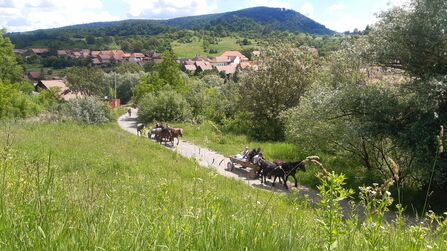
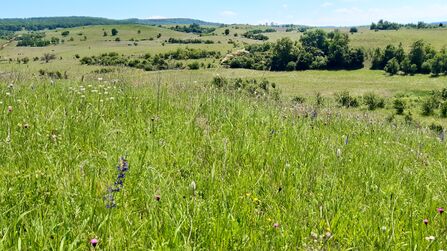
We regrouped after lunch and were treated to a taster of what can only be described as some of the most impressive meadows one could ever wish to be in. Very much a warm-up act for the meadows we’d be seeing tomorrow, we had a walk around one of the grasslands close to Saschiz, where the sheer feeling of ‘landscape’ was the main emotion, with meadows stretching to a horizon where they meet the forest. But once we looked more closely, seeing such great botanical biodiversity was mightily impressive. Oh yes, and as the birders in the group would testify, pretty impressive avian species as well: quail, whinchat, red-backed shrike (they were everywhere!), plus a fly-by of a Montagu’s harrier. Fantastic!

Saschiz meadows

Neil Gibson / Saschiz meadows

Day Three - Flower meadows, Viscri communal grazing and King Charles’s house

The morning was one for the botanists, entomologists, birders, and just about anyone with a soul! We were taken to a rather special area of grasslands, where we were greeted by our guides: Nat Page, President of FA; eminent plant ecologist Owen Mountford; and “The King’s Botanist”, Dr John Akeroyd.

I should explain that last one. Prince Charles, as he was then, first visited Transylvania in 1998 and has spoken of being “totally overwhelmed by its unique beauty”. He has since acquired properties in the Saxon village of Viscri and has been a great supporter of the local area, helping to promote sustainable tourism and local businesses.

Dr John Akeroyd is a British botanist who has frequently served as a botanical guide and adviser to King Charles III (hence the moniker). For over two decades, he has guided the King through the wildflower meadows of Transylvania and collaborated with him on The Transylvania Florilegium, a major royal-commissioned book project recording the region’s plant life.

The King's botanist with Chris Baines, Transylvania

Neil Gibson / The King's botanist with Chris Baines, Transylvania

The meadows and pastures of southern Transylvania represent some of Europe’s most intact traditional farmed grasslands, with low-intensity management practices, little to no fertiliser and low livestock stocking densities. This has allowed a huge diversity of wildflowers and other wildlife to thrive.

These dry grasslands are particularly flower-rich, with the world record for numbers of plant species found in a 2m² quadrat. Just for comparison, in the UK we tend to consider our best chalk grassland as being capable of supporting 40–50 species per square metre, which is why they are often referred to as Europe’s answer to the tropical rainforest. But here in Transylvania, the figures are nearer 80 species per square metre. John informed us that the number of plant species recorded over the whole area we were currently looking at numbered around 240 – impressive stuff indeed.

Stepping off the bus, what hits first is the sound of buzzing as clouds of insects are parted by every footstep.

He (Akeroyd) told the Guardian in 2018: “I can’t emphasise too much the importance of the area. There are other wildflower meadows in Europe but they’re mostly in the mountains. This is still lowland wildflower meadows of a sort that has virtually disappeared in Europe … It gives us a way forward for biodiversity conservation and the Prince is one of the few people who’ve recognised how important this area is.”

Meadow landscape in Transylvania

Neil Gibson / Meadow landscape in Transylvania

The incredibly rich mix of wildflowers included three different species of yellow rattle, many plants valuable for animal nutrition, such as sainfoin, clovers and other legumes, as well as some new-to-me species, like nodding sage, burning bush and Carthusian pink. In Dorset, we are blessed with wonderful flower meadows at the likes of Kingcombe National Nature Reserve, but this was a level or two up – truly inspiring.

Carthusian pink

Neil Gibson / Carthusian pink

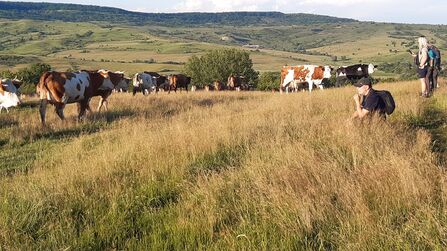
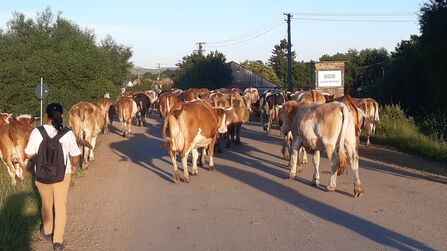
The late afternoon treat was something that we couldn’t miss: witnessing the herd coming in for milking. Not sure what to expect, we all headed up into the hills surrounding Viscri and found that there was a stockman looking after approximately 120 milking cattle. They are a communal herd, owned by 45 different farmers from the village, and every evening they are walked into town, where each farmer directs their respective animals into their smallholding for milking. It is quite difficult to describe the organised chaos, but all the cows seem to know exactly where to turn off with minimum fuss. After milking, all the milk urns are taken to a communal tank in the village for processing – all very fascinating.

Beef consumption is traditionally very low in Romania, and most restaurants focus on pork, sometimes chicken, as the meat element. Pigs were historically cheaper and easier to raise on small, traditional homesteads. For this reason, most of the cattle we saw in the region were ‘milkers’. There is a slow shift towards beef cattle production, but that change may yet influence the future of land management across Romania.

Day Four – Angofa Farm

Set in the Angofa Valley on the site of a former village is FA’s demonstration farm. It is home to a herd of Angus beef cattle and has an education centre for guests and visitors.

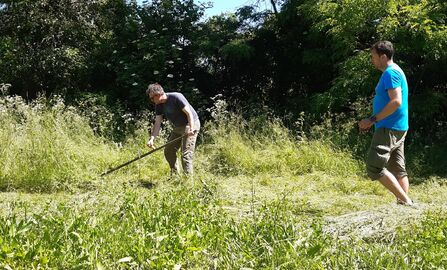
We spent most of the day there, with the first sighting on getting off the bus a family of bee-eaters on the hillside behind the Centre. Immediately we're thinking, "This is a special place". The first hour or so was spent in their classroom hearing how the farm came to be and how it is managed, as well as the challenges faced. Hay is still cut, but these days with machines - the days of using hand scythes for the most part is long gone. For demonstrations, history lessons and very small-scale cutting, scything is still possible to see, and a few of our group, including The Wildlife Trust’s very own Craig Bennett, had a good go at it. 

Overall management of the farm is low-intensity grazing and hay cutting, combined with some scrub control – much like we do here in Dorset, just on a larger scale. The meadows here are also stunning – of course they are – and again, the landscape scale is what strikes the visitor. Very few fences and hard boundaries are seen, other than some electric fencing, so views of large areas of grassland with scrub and trees stretch out to the horizon.

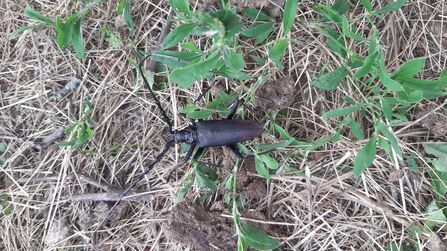
Walking around, we saw lots of butterfly species, plus a goshawk and a lesser-spotted eagle with a snake in its talons. We looked at a pond hawked by dragonflies and were informed that it is a regular wildcat drinking hole. One of my highlights, in a moment of sitting admiring the view, was seeing a stag beetle flying around the edge of a woodland – I’d only ever seen them on woodpiles in the UK.

View from Angofa Farm, Romania

Neil Gibson / Angofa Farm, Romania

At this point I should probably explain why the cattle and sheep farmed in this area are accompanied by full-time, 24-hour stock people. Large top predators are still a major element of the region, and specifically here we are talking about wolves, brown bears, lynx and wildcats. 

During our trip, we unfortunately didn’t see any of these, just bear scat, but our guide for Angofa Farm, Laura, sent us a photo of a bear which she took the day after we were there, more or less where we had walked. Wolves and bears are the main threat to livestock, and it seemed from speaking with the locals that bears were the ones they worried about the most. In fact, even in the towns, bear attacks on humans are a real concern, with a fatality just a few weeks before we arrived.

Bear spotted in Angofa

Neil Gibson / Bear spotted in Angofa 

Day Five – Cheesemakers and bison

Today was one of two days that involved a long drive out, one and a half hours from the guesthouse. In contrast to the wildflower meadows of the last few days, this involved looking at the local farm businesses.

The morning was a visit to Ferma Catean, near Brasov, run by an enterprising young farmer and his famous horse-training brother. The farm uses wildflower meadows to produce traditional cheeses, which, I have to say, we sampled during another indulgent lunch provided by our hosts and which were fantastic.

Even this wasn’t a normal visit for us… Before the farm tour, the brother gave us a demonstration of his extraordinary equine skills. He was trained at the Royal Andalusian Riding School in Spain, and his horses have been used in some major Hollywood productions (Cold Mountain, Napoleon, Zorro).

The picture is the pose at the end of the display – all rather bizarre and unexpected.

Dancing horse in Transylvania

Neil Gibson / Dancing horse

After lunch, we took a trip out to see a shepherd and his sheep on the hill. Again, this was no ordinary shepherd. Back in 2013, Christian Suciu, then a 35-year-old, travelled 1,300 km across five countries with his herd of 300 sheep for more than 100 days, in a project aimed at reviving the tradition of transhumance, the seasonal movement of livestock.

Anyway, like all the sheep herders in these parts, he and his peers stay with the flocks all day and night, accompanied by trusty guard dogs. The Carpathian Shepherd Dog is a large livestock guardian, and these beasts had a job to do – protect the flock from bears. One of these dogs was still showing bloody wounds from a recent bear attack!

Romanian shepherd dog

Neil Gibson / Romanian shepherd dog

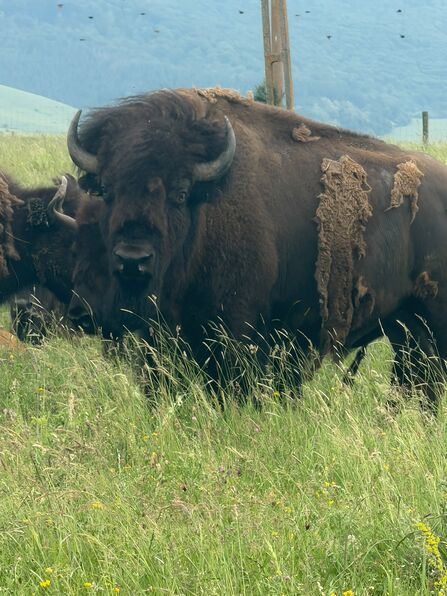
On the way back to the guesthouse, Russ had laid on a detour to a bison farm. Purely a farm rather than a conservation project, the farmer had been running this business for just a year or two, and rather than the Eurasian bison native to eastern Europe (the species used by UK conservation projects), this chap, originally from Hungary, had chosen to use North American bison. Supposedly this was because the American version is easier to farm. It was a fascinating visit, if nothing else to see the level of fencing and handling systems required, including the use of Robinia fenceposts, something we have started to use on our Dorset nature reserves due to their longevity. There was also the usual variety of species to see – more shrikes, wild flowers and insects.

Day Six – Biodiversity project at Cobor Farm and Karpaten Meats

The last full day always brings a sense of melancholy, but there were still two farms to visit. The morning’s adventure started with an epic drive across country, which our driver seemed to have under control, but the feeling wasn’t entirely shared by her passengers. We were taken down some pretty ropey, narrow, unsurfaced tracks, supposedly a short cut, full of deep potholes with unknown depths of water, with the crunching of the bus underside and gasps from the group the soundtrack to most of the journey.

With some relief, we made it unscathed to Cobor Farm, a relatively new (2019) biodiversity project operated by Foundation Conservation Carpathia. Primarily a beef cattle enterprise, the land has a rich biodiversity, but the farm manager, Svea, gave us a picture of frustration at how hard that project has been. Employing reliable local farmers to help with the livestock all the way up to the sale of products has proved to be challenging, but despite this, the business, which also offers wildlife tours and accommodation, is now going well. The cattle breed is a very impressive Romanian Grey Steppe, an ancient hardy breed, known for its signature grey-white coats and long, sharp horns, and historically vital in the region for heavy agricultural work before mechanisation arrived.

The final visit for the week was quite an eye-opener, for many reasons. It was a visit to Karpaten Meats, a large Swiss-owned company rearing Angus beef cattle on extensive grasslands, mainly for export. It was very much a contrast to the other farms we had seen across the week, perhaps a sign of where the modern world could be taking Romania, and maybe a cautionary tale.

For livestock welfare and the production itself, producing high-quality beef under intensive health scrutiny, the operation is mightily impressive. Compared with the small-scale farms we’d mostly seen during the week, with their associated biodiverse meadows, this seemed the other end of the scale. It was a fairly large area (c. 20,000 ha), but with 9,000 head of cattle, it felt like industrial production where the product comes first.

Of course, being Transylvania, we still saw great grey shrike and other species we’d consider ‘exotic’, but it didn’t generate the same excitement, and the grasslands were certainly nowhere near as biodiverse. That said, it was important for us to understand where Romania could be heading, especially in lieu of EU membership and the subsequent grants available to businesses. It hit home how important it is to keep traditional farming viable as a business, not just maintain that way of life in a kind of museum setting. Much food for thought…

Traditional hay stacks in Transylvania

Neil Gibson / Traditional hay stacks in Transylvania 

The evening meal back at the guesthouse was an opportunity for the group to reflect on the week’s adventures, draw conclusions from the things we’d seen and connections we’d made. Since returning to Dorset, of course, it is expected that I would be looking at how we manage our land and questioning whether we can take some of the Romanian model and use it here.

The UK context is that we know that 97% of our wildflower meadows have been lost in the last 100 years, but there is hope: with the will, education and resources, we can restore meadows, and here in Dorset we have been at the forefront of that. I am very fortunate that, with our Kingcombe National Nature Reserve and other nature reserves, we still have some fantastic haymeadows and pasture.

Clearly, we aren’t going to instantly produce Romania-level meadows, but what we can look at is the landscape as a whole and the potential for connectivity. The likes of Lyscombe and Wild Woodbury give Dorset Wildlife Trust opportunities to manage on a grander scale, and across the county, we can encourage neighbouring landowners that landscape-scale connectivity is the best, and possibly only, way that we can return our countryside to a living, biodiverse ecosystem that it once was and can be once again.

Transylvania study tour

Neil Gibson / Transylvania study tour

Acknowledgements

I should say “thank you” to a few folk, as I certainly feel very fortunate to have been given this unique opportunity. Firstly, thanks go to PfL and specifically Russ and Jimmy for the brilliant organisation of this trip; to my CEO Brian Bleese for asking if I’d like to attend on behalf of Dorset Wildlife Trust; to Craig Bennet for instigating the collaboration between The Wildlife Trusts and PfL; to our Romanian hosts, especially Cristi Gherghiceanu, Laura Chirilă-Pașca and Mădălina Marian; the owners and staff of Casa Trappold for looking after us; and of course to each and every one of my cohorts who shared a truly unique experience that week, which I’m sure none of us will forget.

Finally, a message to anyone reading this and who got this far: well done and thank you! If you’re considering a trip to Transylvania, especially if biodiversity of landscape, culture and wildlife is your thing, please, just do it. It’s a magical place.