

Colleen Smith-Moore
Surveying cetaceans along the south coast
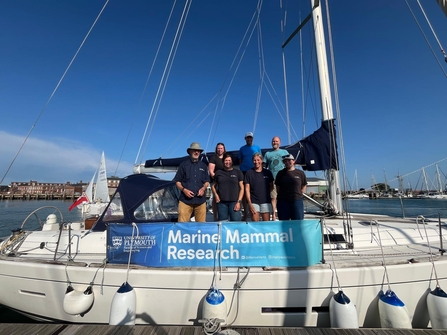
In June 2025, a team from Dorset Wildlife Trust staff joined forces with the University of Plymouth to carry out a five-day visual and acoustic survey for cetaceans along the south coast of England. Wilder Communities Officer, Anona Dawson reflects on the trip.
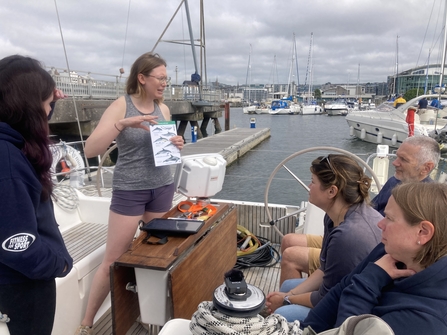
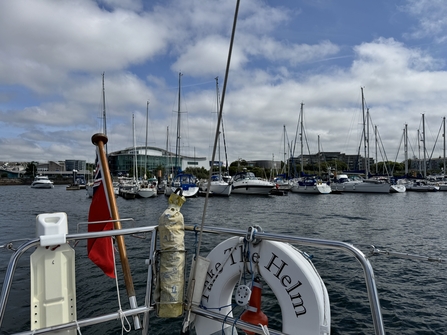
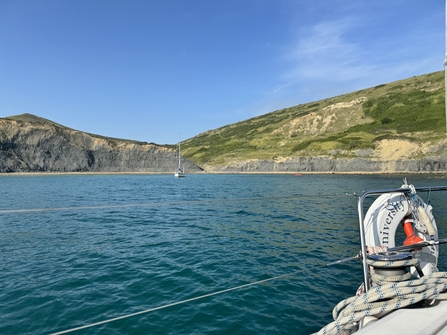
We are a group of people from Dorset Wildlife Trust and Plymouth University and have one thing in common. Love of the ocean and a deep desire to protect it. Under the expert guidance of Dr Simon Ingram, Associate Professor of Marine Biology at Plymouth University and Andy Smith, Yachtmaster and Skipper of Take the Helm the University’s 45-foot Dufour survey yacht, we launch ourselves into an unforgettable five days, equipped with acoustic and visual recording devices and enough food, water and enthusiasm to get us much further. Some of us are new to this. Others are experts. But we are learning, and at the end of day one, we realise just how much. Andy teaches us how to hoist the main sail, navigate a straight course, and tie up in a harbour. And then, on a memorable day, anchor offshore in Chapman's Pool, for a swim in the sea, followed by a hot freshwater shower on deck.
Dorset Wildlife Trust Images
Colleen Smith-Moore
Colleen Smith-Moore
Colleen Smith-Moore
Anona Dawson
Sarah Hodgson
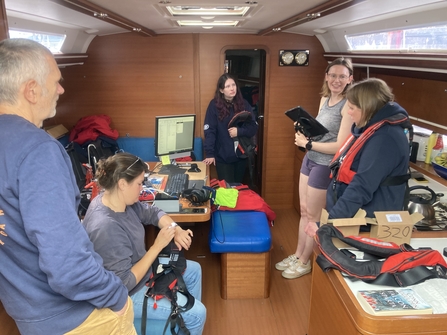
Marine mammals don’t vocalise everything all the time and visual sightings alone are inconsistent. But by towing a hydrophone behind the yacht, which detects deep water echolocation clicks from these animals, alongside clever computer modelling, we can corroborate the visual sighting information, making the surveys much more accurate.PhD student, Plymouth University
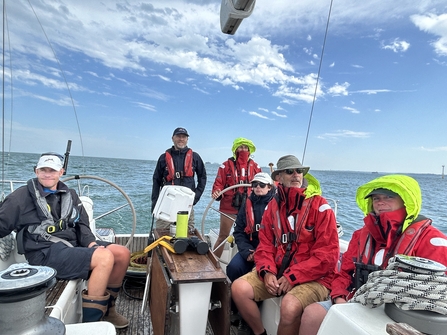
Some of us are new to this. Others are experts. But we are learning, and at the end of day one, we realise just how much. Andy teaches us how to hoist the main sail, navigate a straight course, and tie up in a harbour. And then, on a memorable day, anchor offshore in Chapman's Pool, for a swim in the sea, followed by a hot freshwater shower on deck. We are learning the ropes. How to record, how to sight animals by looking at ripples on the ocean surface, bubbles of white foam, how to identify dorsal fins, barely visible in a sea of blue peaks and troughs. Sea birds are white and black, or just white or just black, minute and subtle differences to the human eye, at distance, standing on a boat, looking through binoculars, moving through the waves.
We settle into a recording routine on deck. Watching the ocean is fascinating, tense, exhilarating, expectant and tiring. Our days are divided into 30 minutes, a clockwise rotation between three. Binoculars trained over starboard, data recording in the centre, binoculars trained to port. Helm course plotting, raising, lowering sails, acoustic recording, tea making, raiding the snack drawer and sleep. We stand polarized against the glare, at first tightly holding on, but gradually getting our sea legs and leaning against the mast or shrouds, staring through binoculars. Our bodies move and brace with the motion of the boat.
The South Coast Bottlenosed Dolphin Consortium is a large community of NGO’s, including Dorset Wildlife Trust, scientists and the public, coming together to share data about marine species along the coast from the Isles of Scilly to Beachy Head in Sussex. It is part of a global initiative designated by the IUCN to identify important areas for marine mammals around the world to try and inform conservation and we are surveying this area to provide data on ranging, size and distribution of species that live in our watersPlymouth University
Sarah Hodgson
Sarah Hodgson
We call out guillemot, shearwater, gannet, terns. Mediterranean, herring, black headed, lesser and greater black-backed gulls, flying, resting, feeding. Sometimes the ocean boils with the turbulence of fish balls and feathers. We see jellyfish, vast swarms of blue, compass and moon pulsating gently past our hull, riding with bubbles and plankton on coastal and ocean currents. The water is languid and calm. We record boats, motor, sailing, ships, leisure and commercial fishing. A trawler tells us over the radio, to move to port. They are trailing fishing gear. A sunfish glides past, lopsided, eyeing us closely, followed by the Trawler. There is litter. We record this, naming sweet wrappers, bottles and pieces of hard, intact plastic, imitating Cuttlefish bones that float amongst them. Bones will disappear, plastic will remain forever, re-entering the food chain somewhere down the line.
Then we see them, 300 metres away and they turn and race towards us. A small pod of common dolphin. They play with us, guiding their calves and teaching them to ride our bow wave. We leap around the boat calling to them, taking photos and video. They watch us, rolling on their sides, skimming the water, then they’re off, leaving us speechless with the privilege of their choice to interact with our human world.
Over the last few decades there have been massive advances in our protection of the seas, lots of designations, policy developments which have really been showing dividends in the state of our natural environment. As the ocean environment improves, we are starting to see other species that aren’t necessarily the focus of our conservation measures such as Humpback whales Bluefin tuna and Common dolphin start to return to our coasts.
And they are swimming straight into an array of potential threats and challenges. We need to futureproof our conservation management and be prepared for the increase in numbers of these species, and how we manage them.
What we don’t want is marine mammals returning to our waters because of our conservation efforts, and swimming into a whole new set of problems that have arisen in the last few decades that weren’t there 50 years ago, that they are suddenly now exposed to. Problems for whales with fishing gear entanglement, in Scotland in particular, is a challenge. Hopefully we can work with the fishing community and conservation bodies to try and modify fishing gear and with the data we provide, prevent this becoming a real issue.
Everyone wants to see lots of whales visiting the coasts along the south of England. But we don’t want to see them swimming straight into problems and hopefully we can mitigate this before it happens by being proactive rather than reactive.Plymouth University
